
📋 Table of Contents
- What Most Families Get Wrong About Budgeting
- The Moment That Changed Everything
- How to Save $500/Month: A Step-by-Step Guide
- Biggest Budgeting Mistakes Families Make
- FAQ: Budgeting Tips for Families
- You’ve Got This
⚡ Featured Snippet Answer: The best budgeting tips for families focus on tracking real spending, automating savings, cutting hidden subscriptions, and meal planning. Families who follow a simple zero-based or 50/30/20 budget consistently save $400–$600 per month — without feeling deprived or cutting out everything fun.
I still remember the night my wife spread our bank statements on the kitchen table and we just… stared. We were making decent money. Where had it all gone?
Turns out, we were bleeding $600 a month on stuff we’d completely forgotten about. Two streaming services we hadn’t opened in months. A gym membership neither of us used. Groceries we let rot. That night changed us — and it can change you too.
These budgeting tips for families worked for us — and they can work for you too.
What Most Families Get Wrong About Budgeting {#problem}
Here’s the thing. Most families think budgeting means suffering.
They picture spreadsheets that take hours, arguments over every dollar, and a life stripped of anything fun. So they either give up before they start, or they make a plan so strict it falls apart by Week 2.
That’s not budgeting. That’s punishment.
Real budgeting is about awareness — knowing where your money is going so you can decide where you want it to go. The goal isn’t to spend less on everything. It’s to stop spending money on things you don’t even care about.
Wow, didn’t know that fact: According to the Consumer Financial Protection Bureau, the average American household wastes roughly $1,500 per year on unused subscriptions alone. That’s $125/month just vanishing. [External link: Consumer Financial Protection Bureau – Managing Your Money]
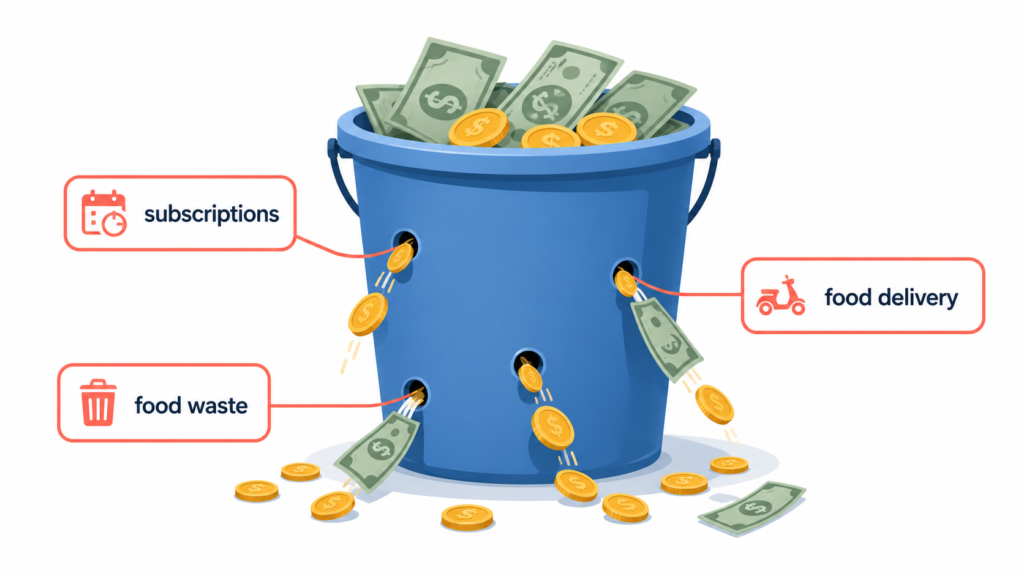
Most families aren’t broke. They’re leaky. And leaks can be fixed.
The Moment That Changed Everything {#turning-point}
Take Sarah and Marcus — two parents of three in Ohio.
They brought home $6,200 a month combined. But they were always stressed about money. They’d fight about random Amazon purchases and then turn around and spend $900 at the grocery store without blinking.
When they finally sat down with a budgeting app — they used YNAB (You Need A Budget) — they discovered something wild: they were spending $340/month on food delivery. Not groceries. Delivery.
They didn’t eliminate it. They capped it at $80/month. That one change alone saved them $260. Add in two forgotten subscriptions ($45), a cable package they downgraded ($70), and a car insurance switch ($110 cheaper per month) — and they were suddenly saving $485 more every single month.
No deprivation. No drama. Just looking.
And that’s where it gets interesting. Most of those savings took them less than two hours to set up.
How to Save $500/Month: A Step-by-Step Guide {#step-by-step}
You don’t need to be a finance nerd to do this. You just need to follow these steps — one at a time.
Step 1: Run a “Money Audit” (Week 1)
Before you cut anything, you need to see everything.
Pull up your last two bank statements and go line by line. Highlight anything that surprises you. Don’t judge — just look. You’re a detective right now, not a critic.
Use an app to make this easier:
- Mint – Free, syncs to your bank, categorizes spending automatically
- Copilot Money – Beautiful interface, great for families (iOS)
- Quicken Simplifi – Strong reporting features, subscription-based
- Goodbudget – Envelope-style budgeting, great for couples
Wow fact: The average family has 3–4 subscriptions they’ve completely forgotten about. Identifying just those can save $40–$120/month instantly.
Track every category: groceries, dining out, entertainment, kids’ activities, personal care, subscriptions, utilities. Give every dollar a label.
Step 2: Find Your “Invisible Leaks” (Week 1–2)
The best budgeting tips for families always start with one thing: seeing your numbers clearly.
Now look for the patterns.
Where are you spending money out of habit rather than intention? Common culprits:
- Unused gym memberships or apps
- Streaming services you cycle through but forget to cancel
- Daily coffee runs that add up to $80–$120/month
- Grocery over-buying that leads to food waste (U.S. families throw away $1,500 worth of food per year on average)
- Impulse buys tied to stress or boredom
Pick your top 2–3 leaks and just plug them. Don’t try to fix everything at once. Fix the biggest holes first.
Wait — before you do that: Don’t cancel things impulsively. Some subscriptions renew annually. Check renewal dates before canceling so you don’t lose money you already paid.
Step 3: Build a Realistic Family Budget (Week 2)
This is one of the most effective budgeting tips for families using the 50/30/20 rule.
The 50/30/20 rule is a solid starting point:
- 50% → Needs (housing, groceries, utilities, transportation)
- 30% → Wants (dining out, entertainment, hobbies)
- 20% → Savings and debt repayment
For a family earning $5,000/month after tax, that means:
- $2,500 for needs
- $1,500 for wants
- $1,000 toward savings/debt
Most families are shocked to find their “wants” category is actually eating into their needs — or worse, their savings.
[NerdWallet – How to Budget Using the 50/30/20 Rule]
Use YNAB or Goodbudget to assign every dollar a job before the month starts. This is called zero-based budgeting, and it’s incredibly effective for families because it removes the guesswork.
Step 4: Automate Your Savings (Week 3)
Here’s a truth nobody tells you: willpower is unreliable.
You won’t “remember” to save money at the end of the month. Life gets in the way. Kids need something. Something breaks. You’re tired.
Automate it. Set up an automatic transfer from your checking to a separate savings account the day after payday. Even $100/week adds up to $5,200/year.
Start with whatever feels painless — $50, $100, $200. Then increase it by $25 every couple of months.
Wow fact: Automating savings increases the likelihood of actually saving by over 80%, according to behavioral economics research. You stop thinking about it — and that’s the point.
Biggest Budgeting Mistakes Families Make
Even families following budgeting tips for families can fall into these traps.
These aren’t small errors. These are the ones that derail entire households.
1. Budgeting together in theory, but not in practice. Both partners need to be involved. A budget one person builds and guards in secret always fails. Sit down monthly — even 20 minutes — to review together.
2. Forgetting irregular expenses. Car registration. Holiday gifts. Back-to-school shopping. These aren’t surprises — they’re just expenses you didn’t plan for. Add them to your monthly budget as small, recurring “sinking funds.” $40/month toward Christmas means $480 by December. No credit card needed.
3. Not budgeting for fun. A budget with zero fun money is a budget you’ll abandon. Give every family member — adults and kids — a small “no questions asked” spending fund each month. Even $20 each preserves sanity and reduces resentment.
4. Comparing your budget to other families. Your neighbor’s spending is not your benchmark. You don’t know their income, their debt, their family size. Focus on your own numbers.
5. Quitting after one bad month. Some months will be disasters. The car breaks. Someone gets sick. You go over in every category. That doesn’t mean budgeting failed — it means life happened. Reset and start fresh next month. That’s it.
FAQ: Budgeting Tips for Families {#faq}
Q: How do budgeting tips for families differ from individual budgets? Family budgets account for multiple incomes, multiple spending personalities, shared goals, and child-related expenses like childcare, school supplies, and extracurriculars. They also require buy-in from all adults involved — which makes communication a key part of the strategy.
Q: What is the fastest way for a family to save $500 per month? The fastest route is identifying and cutting “invisible” expenses — unused subscriptions, food delivery habits, impulse purchases — and automating savings before you can spend what you intended to keep. Most families can find $300–$500 in leaks within 30 days of tracking.
Q: Which budgeting app is best for families? YNAB is widely considered the gold standard for serious family budgeting because it forces intentional allocation of every dollar. Mint is great for beginners since it’s free and auto-categorizes. Goodbudget works well for couples using the envelope method. The best app is the one your whole family will actually use.
Q: How do we budget with an irregular income? Base your monthly budget on your lowest expected income month from the past six months. When you earn more, send the extra directly to savings or debt. This prevents overspending in high-income months and protects you during low ones.
Q: Should kids be involved in family budgeting? Yes — age-appropriately. Kids as young as 5 can learn about saving with a piggy bank. Older kids benefit from seeing a simplified version of the family budget. It builds financial literacy early and reduces “can I have…?” friction when kids understand there’s a plan.
You’ve Got This
Look — nobody teaches families how to do this.
You didn’t get a class on household cash flow. Your parents probably didn’t talk about money openly. And there are entire industries built to make sure you keep spending without thinking.
But here’s what I know: once you see your money clearly, you can’t unsee it. And once you plug those leaks and watch your savings account actually grow — even slowly — something shifts. You feel less stressed. Less reactive. More in control.
$500/month is $6,000 a year. That’s a family vacation. An emergency fund. A chunk of debt gone. A step toward something bigger.
You don’t need to be perfect. You don’t need a finance degree. You just need to start — this week, with 30 minutes and your last two bank statements.
These budgeting tips for families are simple — but only if you actually start.
The family that does this together builds something most people never have: financial breathing room. And that feeling? It’s worth every minute.
This article is for educational purposes only and does not constitute financial advice. Always consult a certified financial advisor before making financial decisions.